
Agentic AI Risk: Why GRC Teams Need to Govern AI That Can Act
AI governance has already moved from policy to regulation. The next frontier is more complex: AI systems that do not just generate content or insight, but take action.
AI governance has already moved from policy paper to board-level accountability.
Over the past 18 months, organisations have been working to understand how AI should be governed, what frameworks apply, how AI systems should be inventoried, and what controls are needed to use AI responsibly.
That was the first phase of AI governance.
The next phase is more complex.
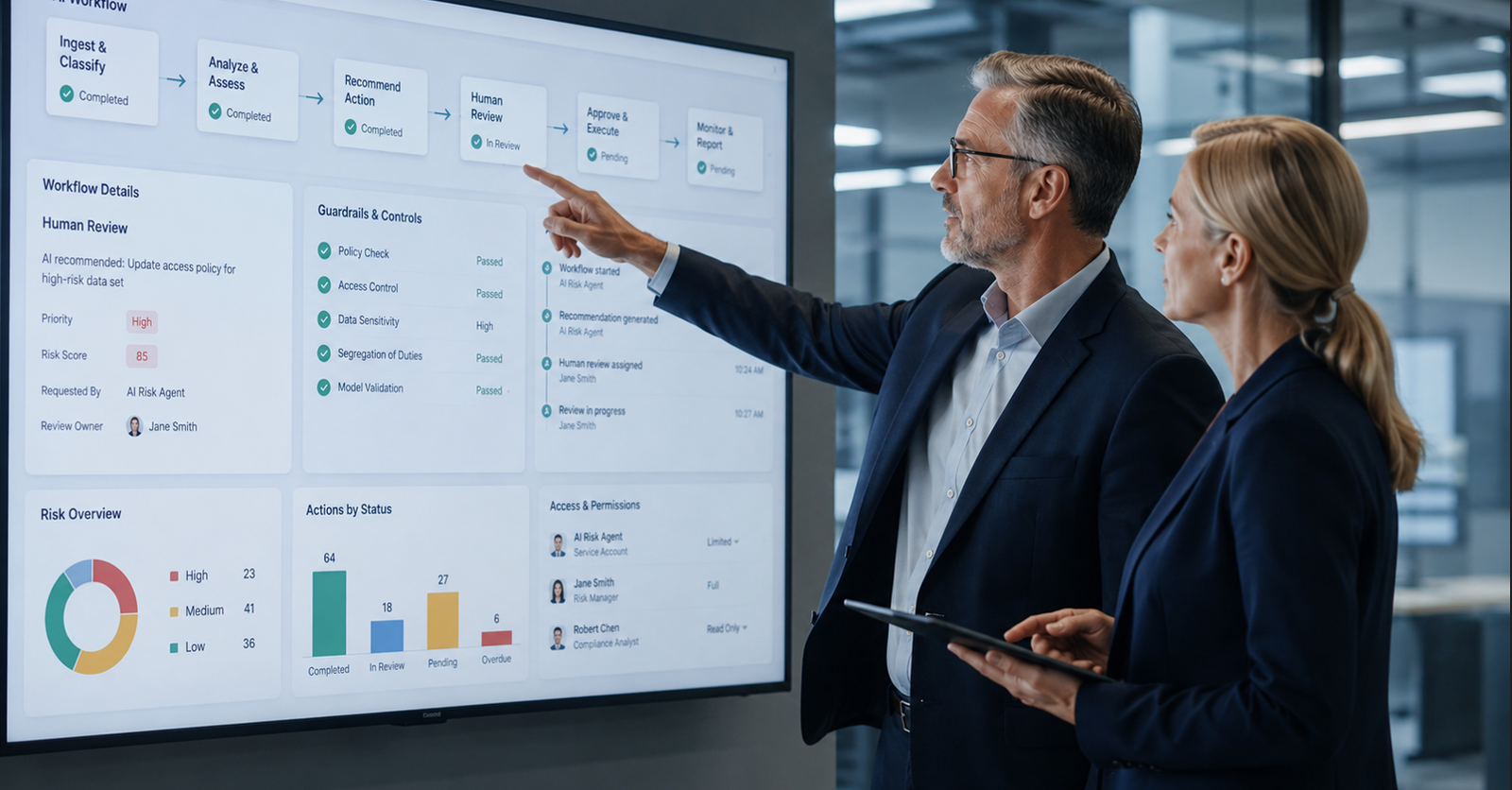
Organisations are no longer only experimenting with AI tools that generate text, summarise documents, support research, or analyse information. They are beginning to deploy AI agents that can perform tasks, access enterprise systems, trigger workflows, update records, recommend decisions, and in some cases act with limited human intervention.
That changes the governance question completely.
The issue is no longer simply:
Can this AI system be used safely?
The new question is:
What is this AI allowed to do?
For GRC teams, this is a major shift. Agentic AI introduces a new category of risk because it combines intelligence, access, autonomy and action. If left unmanaged, it can create control failures, data exposure, poor decision-making, accountability gaps and regulatory risk at enterprise scale.
The organisations that get this right will be able to adopt AI faster and more safely. Those that do not may find themselves forced to slow down, roll back or restrict AI initiatives because governance has not kept pace with capability.
What Makes Agentic AI Different?
Traditional AI tools usually support a human user. They generate an output, and the human decides what to do with it.
Agentic AI goes further.
An AI agent can be designed to pursue a goal, plan a series of steps, interact with systems, retrieve data, make recommendations, prepare actions, trigger workflows, and monitor outcomes. In a business context, this could include:
- Reviewing compliance obligations and suggesting control updates
- Monitoring third-party risk and escalating supplier issues
- Analysing incidents and recommending remediation actions
- Updating risk registers based on emerging signals
- Drafting audit findings and assigning follow-up tasks
- Reviewing policy exceptions and routing approvals
- Monitoring regulatory change and mapping it to obligations
This creates enormous potential.
It also creates a new governance challenge.
When AI moves from producing information to initiating action, risk management must move from passive oversight to active control.
The New GRC Risk Equation: Autonomy + Access
The risk of agentic AI is not only about whether the model is accurate.
It is about what the agent can access and what it can do.
A low-quality AI output is a problem. But a low-quality AI output that triggers a workflow, updates a record, notifies a regulator, changes a control status, escalates an issue, or makes a customer-impacting recommendation is a much bigger problem.
This is why GRC teams need to assess AI agents through two critical dimensions:
Autonomy: How much can the AI do without human approval?
Access: What systems, data, workflows and decisions can it influence?
The greater the autonomy and the greater the access, the stronger the governance model needs to be.
An AI agent that summarises public regulatory updates may require light governance. An AI agent that updates compliance obligations, assigns actions, assesses control failures, or recommends management responses requires much stronger oversight.
This is where many organisations will need to rethink their AI governance models.
A simple acceptable-use policy is not enough.
Four Control Levels for AI Agents
A practical way to govern agentic AI is to define levels of permitted action.
Not every AI agent should be treated the same. Some should only observe. Some may advise. Some may prepare actions for human approval. Only a limited number should be allowed to act autonomously, and only within strict guardrails.
1. Observe
At this level, the AI agent can read, monitor and analyse information, but cannot make changes or trigger actions.
This may include scanning regulatory updates, identifying risk signals, summarising incidents, or highlighting trends.
The governance requirement is relatively light, but organisations still need access controls, data protection rules, audit logs and clear ownership.
2. Advise
At this level, the agent can recommend actions, but a human must decide whether to proceed.
For example, it may recommend that a risk rating be reviewed, a control be strengthened, or an obligation be mapped to a business process.
The key control is that the AI provides advice, not authority.
3. Act with Approval
At this level, the agent can prepare an action, but a human must approve it before execution.
This could include drafting a remediation plan, preparing a workflow task, suggesting an escalation, or creating a proposed update to a risk register.
This is often the most practical model for GRC because it combines AI efficiency with human accountability.
4. Act Autonomously
At this level, the agent can take action without human approval, but only within tightly defined boundaries.
This may be appropriate for low-risk, repetitive, rules-based tasks, such as sending reminders, routing items to the correct owner, or flagging overdue actions.
However, autonomous action should be limited, monitored and fully auditable. High-risk decisions should remain human-led.
What GRC Teams Need to Operationalise
To govern agentic AI properly, organisations need more than a policy. They need an operating model.
That operating model should include the following components.
1. AI Agent Inventory
You cannot govern what you cannot see.
Every AI agent should be recorded in a central inventory, including its purpose, owner, data access, system access, permitted actions, risk classification, approval status and monitoring requirements.
The inventory should include both internally developed agents and vendor-provided AI capabilities embedded in enterprise platforms.
2. Risk Classification
Each AI agent should be assessed based on impact, autonomy, access, data sensitivity and decision influence.
A simple productivity assistant should not be governed in the same way as an agent that supports compliance decisions, risk scoring, audit findings, customer outcomes or regulatory reporting.
The governance model must be proportionate.
3. Access and Permission Controls
AI agents should not receive broad system access by default.
They need role-based permissions, least-privilege access, clear data boundaries and approval rules for sensitive actions.
If an AI agent can access confidential data, regulated information, personal information or commercially sensitive records, that access must be justified, controlled and monitored.
4. Human-in-the-Loop Review
For material actions, human review should be built into the workflow.
The question is not whether humans should be involved. The question is where human judgement is required.
Human review is especially important where AI outputs affect legal obligations, risk ratings, control effectiveness, incident responses, supplier decisions, customer outcomes or board reporting.
5. Guardrails and Control Mapping
AI agents need defined guardrails.
These may include prohibited actions, approval thresholds, escalation rules, data-use restrictions, output validation requirements and exception handling.
Each guardrail should be mapped to a relevant risk, control or compliance obligation so that the governance model is not abstract. It should be connected to the organisation’s existing GRC framework.
6. Audit Trails and Evidence
Every meaningful AI action should create evidence.
GRC teams need to know what the agent did, what data it used, what recommendation it made, who approved it, what action was taken, and whether the outcome was reviewed.
Without an audit trail, agentic AI becomes difficult to defend.
In a regulated environment, that is a serious weakness.
7. Incident and Exception Management
AI agents will make mistakes.
They may misclassify information, recommend the wrong action, rely on incomplete data, escalate unnecessarily, or fail to detect a material issue.
Organisations need a clear process for logging AI incidents, investigating failures, correcting outcomes, updating controls and reporting material issues.
AI governance must include continuous improvement, not just approval at deployment.
8. Board and Executive Reporting
Boards do not need technical detail on every AI agent.
They need a clear view of enterprise exposure.
Useful reporting should answer:
How many AI agents are in use?
Which business areas use them?
Which agents are high risk?
What systems and data can they access?
What actions can they perform?
What incidents or exceptions have occurred?
Which controls are failing?
Where is human approval required?
What risks require executive attention?
This turns agentic AI governance into a board-level risk discipline.
Why This Matters for Risk, Compliance and Audit
Agentic AI will affect every major GRC domain.
In risk management, AI agents may identify emerging risks, update risk indicators, suggest risk ratings or trigger escalation workflows.
In compliance, they may monitor regulatory change, map obligations, assess control gaps and recommend remediation.
In audit, they may analyse control evidence, identify anomalies, draft findings or track management actions.
In third-party risk, they may monitor suppliers, scan external signals, assess contractual exposure and flag changes in vendor risk.
In incident management, they may classify events, recommend escalation paths and assign response actions.
This is powerful, but it also changes the control environment.
When AI becomes part of the workflow, it becomes part of the risk system.
That means it must be governed like any other material control, process or decision-support mechanism.
The Accountability Problem
One of the biggest risks with agentic AI is accountability.
If an AI agent recommends a control change and the business accepts it, who is accountable?
If an AI agent fails to escalate a regulatory issue, who owns the failure?
If an AI agent acts on incorrect data, who is responsible for the outcome?
The answer cannot be “the AI”.
Accountability must remain human.
Every AI agent needs a business owner, a control owner, and a clear approval path. The organisation must be able to explain who approved the agent, what it was allowed to do, how it was monitored, and who was responsible for acting on its outputs.
This is where governance must be practical, not theoretical.
Agentic AI cannot sit outside the enterprise control framework. It must be embedded into it.
From AI Governance to Agentic Risk Management
Most organisations are still building the first layer of AI governance: policies, inventories, acceptable-use rules and risk assessments.
That work remains important.
But agentic AI requires the next layer.
It requires governance over autonomy, access, workflow permissions, system actions, evidence, monitoring and accountability.
This is the move from AI governance to agentic risk management.
The organisations that make this shift early will be better positioned to adopt AI at scale. They will be able to move faster because they will have defined the rules of safe deployment.
The organisations that delay may face the opposite problem: AI adoption grows faster than governance can control, creating unmanaged exposure across systems, processes and decisions.
The Future of GRC Is Human-Led and AI-Enabled
Agentic AI should not replace governance professionals.
It should extend their reach.
AI agents can monitor more information, detect more patterns, reduce manual administration, accelerate evidence gathering and help route issues faster. But human judgement remains essential.
The strongest model is human-led and AI-enabled.
AI agents observe, analyse, recommend and assist.
Humans set the boundaries, validate the outputs, approve material decisions and remain accountable for outcomes.
This is the governance model enterprises need as AI becomes more operational.
Final Thought
AI governance is no longer only about controlling what people type into a chatbot.
The next challenge is governing AI that can act.
As AI agents become embedded into enterprise workflows, GRC teams will need to answer harder questions about autonomy, access, permissions, evidence, oversight and accountability.
That is not a future problem.
It is already emerging.
The organisations that prepare now will be able to scale AI with confidence.
Those that do not may find themselves asking a difficult question too late:
Who gave the AI permission to do that?
About the author
Unify Today Editorial
GRC Insight Team