
AI Governance Frameworks: A Practical Guide for 2026
EU AI Act, NIST AI RMF, ISO 42001, a practical breakdown of what each framework requires and how to operationalise them.
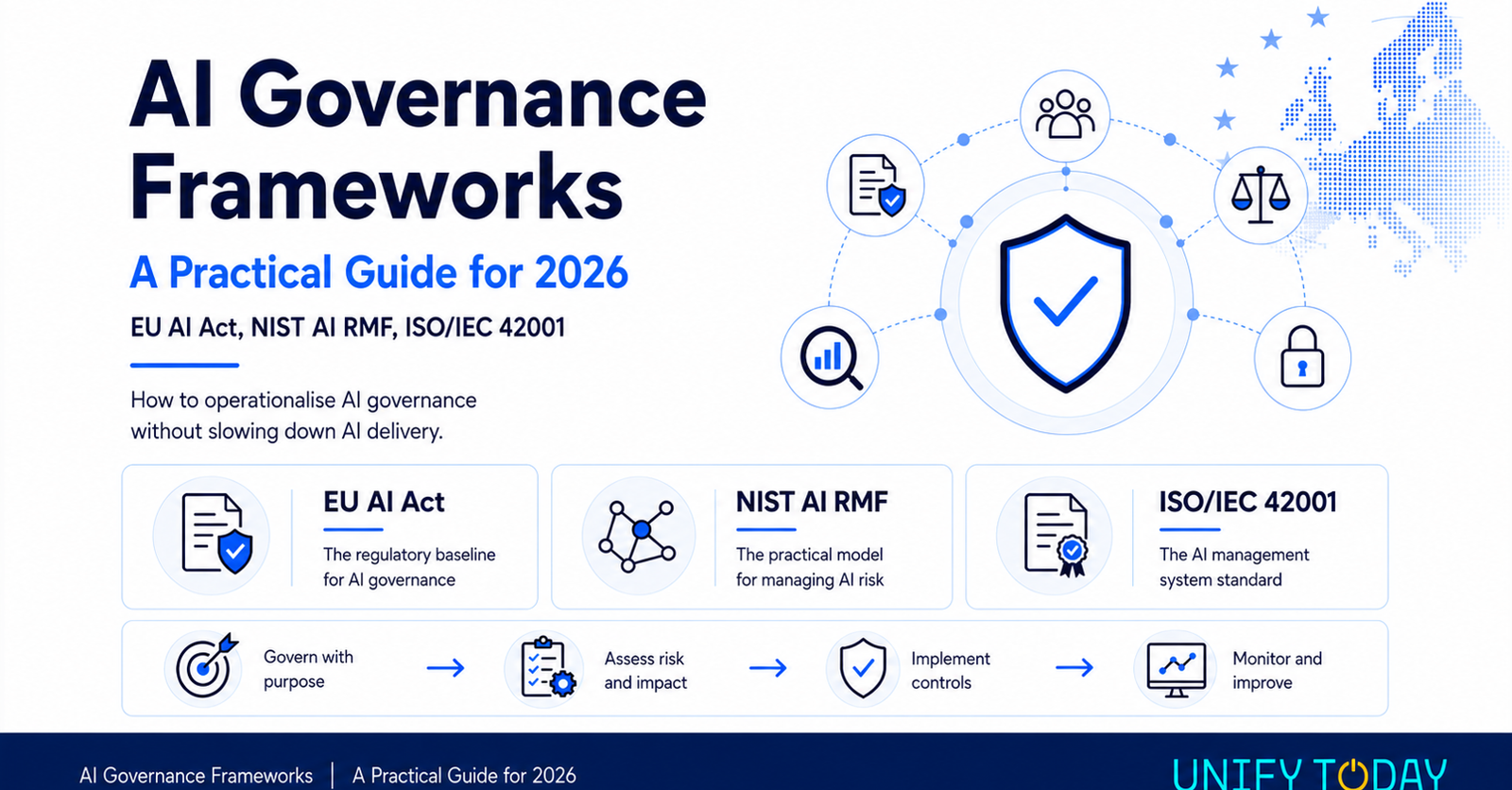
AI governance has moved from policy discussion to enforceable accountability.
For boards and executives, the question is no longer whether the organisation is experimenting with AI. Most already are. The real question is whether those AI systems are known, assessed, controlled, monitored and defensible.
In 2026, three frameworks matter most: the EU AI Act, the NIST AI Risk Management Framework, and ISO/IEC 42001.
Each serves a different purpose. The EU AI Act sets regulatory obligations. NIST provides a practical risk management model. ISO/IEC 42001 establishes a management system for governing AI responsibly.
Together, they form the backbone of modern AI governance.
The challenge is not understanding these frameworks in theory. It is operationalising them without slowing down AI delivery.
Why AI Governance Matters Now
AI has moved into core business processes: customer service, recruitment, fraud detection, compliance monitoring, document review, cyber security, marketing, decision support and software development.
That creates opportunity, but also risk.
AI systems can produce biased outputs, expose confidential data, generate inaccurate recommendations, create opaque decision-making, breach intellectual property rules, or embed risks into business workflows faster than traditional governance teams can respond.
Boards now need defensible answers to basic questions:
What AI systems do we use?
Who owns them?
What data do they rely on?
What decisions do they influence?
What risks have been assessed?
What controls are in place?
How are outputs monitored?
Can we prove this to regulators, customers and auditors?
This is where the three major frameworks become practical.
1. The EU AI Act: The Regulatory Baseline
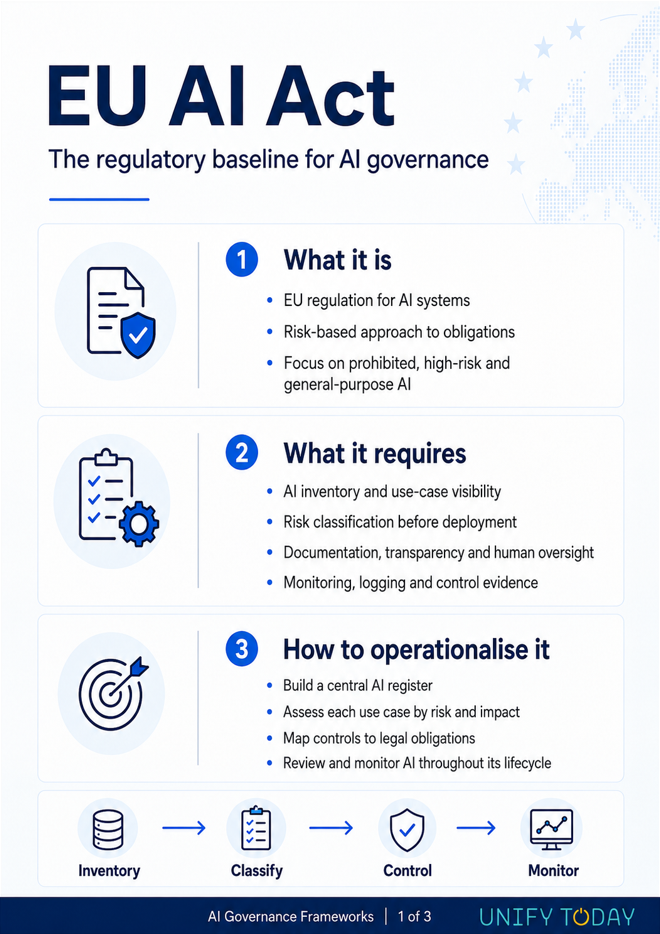
The EU AI Act is the most important regulatory development in AI governance. It entered into force on 1 August 2024, with phased application of obligations through 2025, 2026 and beyond. The European Commission’s implementation timeline confirms that key provisions apply progressively, including prohibited AI practices, AI literacy requirements, general-purpose AI obligations and broader high-risk AI rules.
The Act uses a risk-based model. AI systems are generally categorised by their level of risk, with stricter requirements for high-risk use cases and prohibitions for certain unacceptable-risk applications.
For organisations, the practical implication is clear: you need to know where AI is being used, what risk category it falls into, and what obligations apply.
High-risk AI systems may require stronger governance over data quality, technical documentation, human oversight, accuracy, robustness, cyber security, logging, transparency and post-market monitoring. General-purpose AI obligations also began applying from August 2025, increasing the need for organisations to understand where foundation models are being used in their technology stack.
How to operationalise it
Start with an AI inventory.
This should not be a spreadsheet buried in IT. It should be a living register of AI use across the organisation, including internally developed AI, vendor AI, embedded AI in enterprise tools, generative AI use cases and experimental pilots.
For each AI system, record:
System name and business owner
Purpose and use case
Vendor or internal development team
Data sources used
Users and affected stakeholders
Decision impact
Risk classification
Relevant jurisdiction
Applicable controls
Monitoring requirements
Evidence and documentation
Then create a formal AI risk classification workflow. Every new AI use case should be assessed before deployment, not after it is already embedded into the business.
The goal is not to stop AI. The goal is to separate low-risk productivity tools from higher-risk systems that affect people, rights, safety, finance, employment, customers or regulated decisions.
2. NIST AI RMF: The Practical Risk Management Model
The NIST AI Risk Management Framework is not a regulation, but it is one of the most useful operating models for managing AI risk. NIST describes the framework as a way to help manage risks to individuals, organisations and society associated with AI.
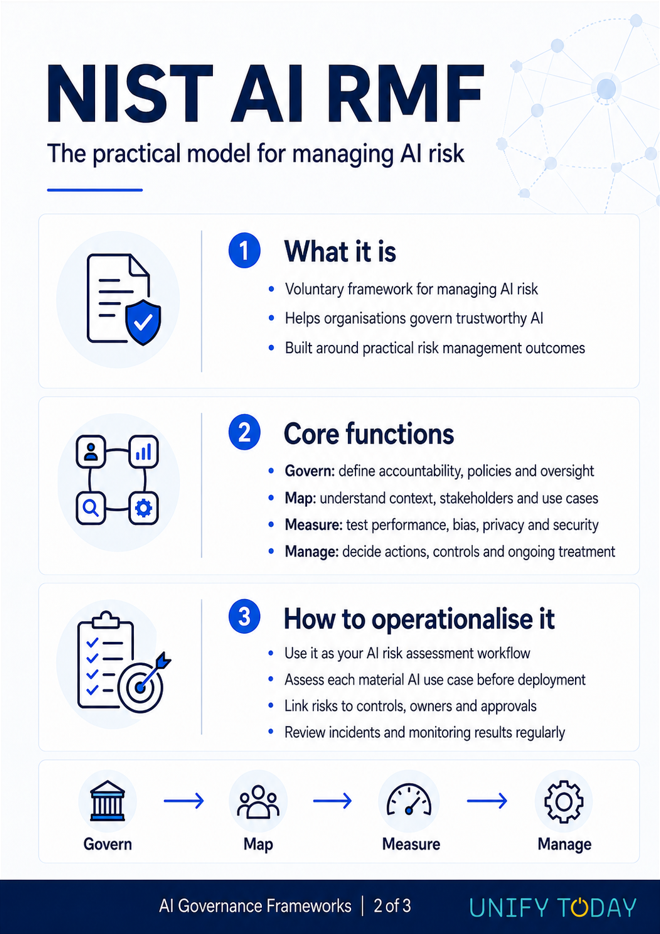
Its strength is that it turns AI governance into four practical functions:
Govern
Map
Measure
Manage
NIST’s AI RMF Core is built around these four functions, with categories and subcategories that help organisations identify actions and outcomes for trustworthy AI.
Govern
This is the foundation. It covers policies, accountability, roles, risk appetite, oversight, procedures and culture.
In practical terms, organisations need to define who is responsible for AI governance. That usually includes the board, executive management, risk, compliance, legal, privacy, cyber security, technology, data teams and business owners.
Map
This means understanding the context of the AI system.
What is it designed to do?
Who may be affected?
What data does it use?
What business process does it support?
What could go wrong?
What legal, ethical or operational risks exist?
Measure
This involves assessing and testing AI risk.
That may include bias testing, accuracy testing, privacy review, cyber security assessment, explainability analysis, model validation, data quality checks and human oversight review.
Manage
This is where risk treatment happens.
The organisation decides whether to approve, restrict, redesign, monitor, pause or retire an AI system. Risks are assigned to owners, controls are implemented, and monitoring is put in place.
How to operationalise it
Use NIST as your AI risk assessment engine.
For every material AI use case, create a structured workflow that asks:
What is the intended purpose?
What are the potential harms?
What stakeholders are affected?
What controls are required?
How will performance be tested?
What human oversight is needed?
How will incidents be escalated?
When should the system be reviewed?
This creates a repeatable governance process rather than a one-off AI ethics discussion.
3. ISO/IEC 42001: The AI Management System
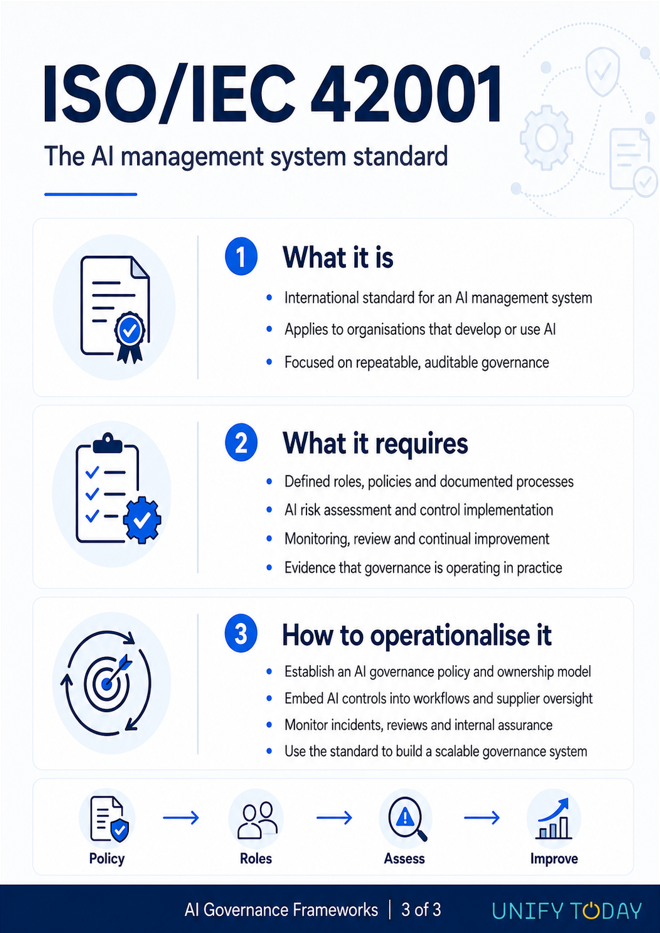
ISO/IEC 42001 is the international standard for an Artificial Intelligence Management System. ISO describes it as specifying requirements for establishing, implementing, maintaining and continually improving an AI management system within organisations that provide or use AI-based products or services.
This matters because AI governance cannot rely on isolated policies. It needs a management system.
That means defined ownership, documented processes, risk assessment, controls, monitoring, continual improvement, internal review and auditable evidence.
ISO/IEC 42001 is especially useful for organisations that want to demonstrate mature AI governance to customers, regulators, boards, investors or enterprise procurement teams.
How to operationalise it
Treat ISO/IEC 42001 as the operating system for AI governance.
That means creating:
An AI governance policy
Defined AI roles and responsibilities
AI risk assessment processes
Supplier and third-party AI controls
Data governance requirements
Human oversight requirements
Monitoring and measurement processes
Incident and issue management
Internal audit and review mechanisms
Continual improvement processes
The value of ISO/IEC 42001 is that it helps move AI governance from “we have a policy” to “we have a managed, repeatable and auditable system”.
How the Three Frameworks Work Together
The mistake many organisations make is treating these frameworks as separate compliance projects.
They should not be.
A practical model looks like this:
EU AI Act defines the regulatory obligations.
NIST AI RMF provides the risk assessment method.
ISO/IEC 42001 provides the management system.
In other words:
The EU AI Act tells you what you may be required to comply with.
NIST helps you assess and manage AI risk.
ISO/IEC 42001 helps you govern the full AI lifecycle.
Together, they create a defensible AI governance model.
The Practical AI Governance Operating Model
To operationalise AI governance in 2026, organisations should focus on seven building blocks.
1. AI Inventory
You cannot govern what you cannot see.
Create a central register of all AI systems, including vendor tools, internal models, generative AI usage, embedded AI features and shadow AI use cases.
2. AI Risk Classification
Not all AI needs the same level of governance.
Classify AI systems by risk, impact and regulatory exposure. Low-risk productivity use cases should not be governed in the same way as systems influencing employment, credit, safety, healthcare, legal rights or customer outcomes.
3. AI Governance Workflow
Every new AI system should pass through a workflow before deployment.
This should include business approval, legal review, privacy review, cyber review, data assessment, risk assessment, control mapping and monitoring requirements.
4. Control Library
Create a reusable AI control library.
Controls should cover data quality, bias testing, human oversight, explainability, access control, vendor assurance, model monitoring, incident response, documentation, audit logs and output review.
5. Third-Party AI Governance
Many organisations will not build their own AI models, but they will use AI embedded in vendor platforms.
That means procurement and vendor risk management must evolve. AI due diligence should become part of third-party onboarding and ongoing supplier monitoring.
6. Monitoring and Incident Management
AI governance does not end at deployment.
Systems should be monitored for performance drift, unexpected outputs, user complaints, data leakage, bias indicators, control failures and regulatory changes.
AI incidents should be logged, triaged, investigated and escalated like other material risk events.
7. Board Reporting
Boards do not need technical model documentation.
They need clear answers:
How many AI systems do we use?
How many are high risk?
Where are the material exposures?
Which controls are failing?
What incidents have occurred?
What regulatory obligations apply?
What decisions require board attention?
This is where AI governance becomes part of enterprise risk oversight.
How to Avoid Slowing Down AI Delivery
Good AI governance should not block innovation. It should make AI safer to scale.
The key is proportionality.
Low-risk AI use cases should move through a lightweight approval path. Higher-risk systems should receive deeper review. Reusable controls, standardised assessments and automated workflows can reduce friction.
The goal is to create guardrails, not gates.
AI teams should know the rules before they build. Business teams should know when review is required. Risk and compliance teams should have visibility without becoming bottlenecks.
The best organisations will embed AI governance into delivery workflows, procurement processes, model development lifecycles and enterprise risk systems.
That is how AI governance becomes practical.
The 2026 Board-Level Question
By 2026, boards should no longer accept vague AI updates.
They should be asking for evidence.
Not just whether the organisation has an AI policy, but whether it has an AI governance system.
Not just whether teams are using AI, but whether AI use is inventoried, assessed, controlled and monitored.
Not just whether AI is creating value, but whether the organisation can prove that value is being delivered responsibly.
The EU AI Act, NIST AI RMF and ISO/IEC 42001 each provide part of the answer.
But the real test is operational.
Can the organisation turn AI governance into daily practice?
Because in 2026, defensible AI governance is not a policy document.
It is an operating capability.
About the author
Unify Today Editorial
GRC Insight Team