
How Mining Companies Are Using AI to Sense Risk Before It Strikes
From tailings dam monitoring to community sentiment analysis, AI is reshaping how mining companies anticipate and prevent operational risk.
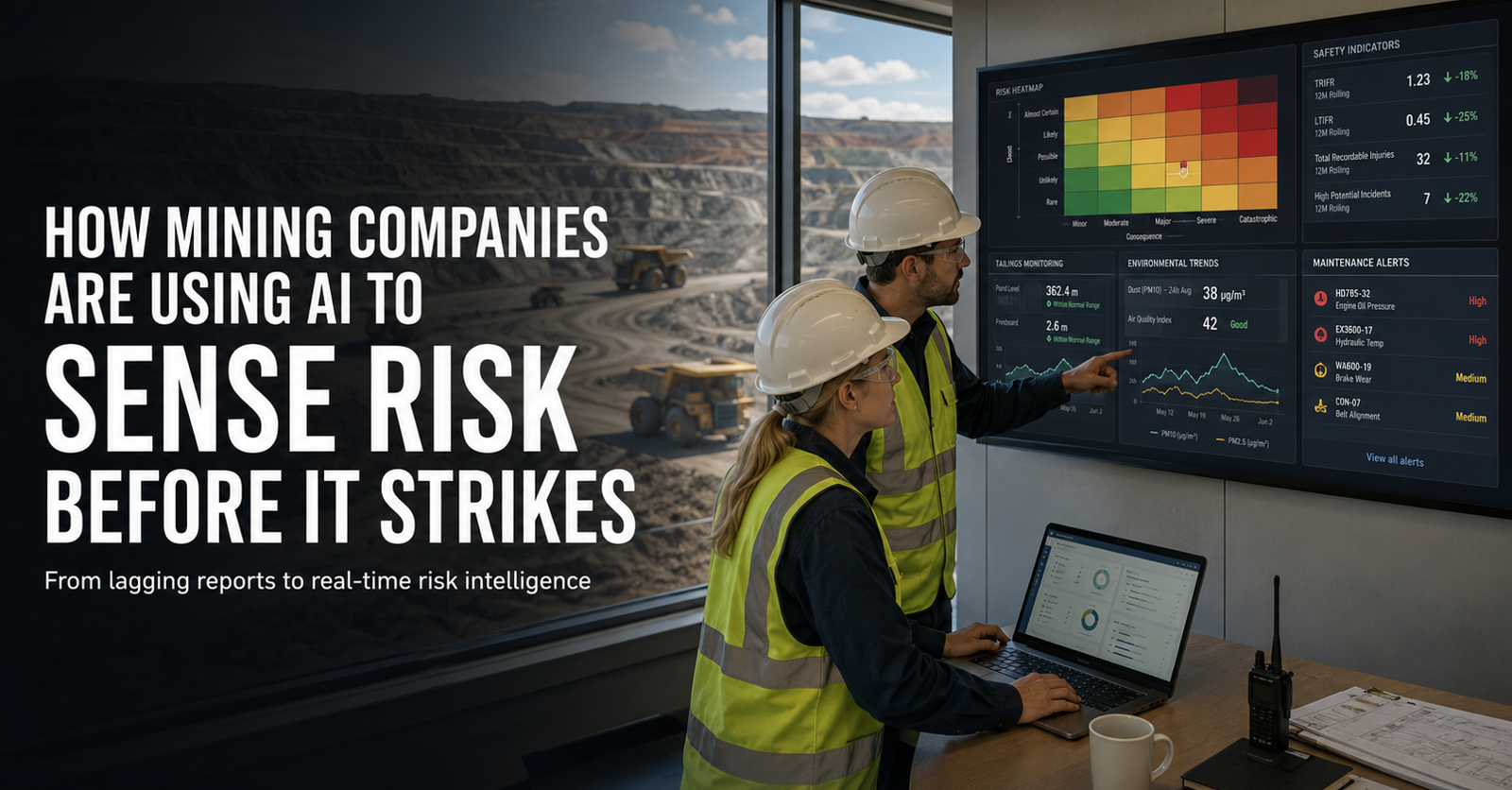
Mining is one of the world’s highest-consequence industries.
A single tailings dam failure, underground safety event, environmental breach, cyber incident, or community conflict can cost lives, destroy ecosystems, halt production, trigger regulatory action, and permanently damage a company’s social licence to operate. The Global Industry Standard on Tailings Management was introduced specifically to prevent catastrophic tailings failures and improve safety across the sector, reflecting just how material these risks have become.
Yet many mining companies still manage risk through processes designed for a slower world.
Quarterly risk registers. Manual SHEQ inspections. Lagging incident reports. Static compliance checklists. Periodic audits. Spreadsheet-based action tracking.
These tools remain necessary, but they are no longer sufficient.
Modern mining operations are dynamic, data-rich environments. Equipment is moving constantly. Weather conditions change quickly. Contractors rotate on and off site. Communities respond in real time. Regulators expect stronger evidence. Operational decisions made on one shift can create risk exposure on the next.
The issue is not that mining companies lack data. Most have more data than ever before.
The issue is that risk signals are often trapped in disconnected systems.
Sensor readings sit in operational technology platforms. Maintenance alerts sit in asset systems. Safety observations sit in SHEQ tools. Environmental data sits in monitoring databases. Community complaints sit in stakeholder systems. Audit findings sit in reports. Regulatory obligations sit in compliance spreadsheets.
By the time these signals are manually consolidated, the risk may already have moved.
This is where AI is beginning to change the role of risk management in mining.
AI gives mining companies the ability to move from lagging risk reporting to early risk sensing.
Instead of waiting for an incident to occur, AI can help identify weak signals, anomalies, patterns and correlations across operational, safety, environmental, regulatory and social data. Industry analysis already points to AI being used in mining to analyse real-time sensor and operational data, helping detect dangerous changes such as temperature or vibration shifts before they lead to harm.
Consider tailings management.
Traditional assurance may rely on scheduled inspections, engineering reviews and compliance reporting. These remain essential. But AI-enabled risk sensing can strengthen the picture by continuously monitoring data such as water levels, deformation, vibration, seepage indicators, rainfall, satellite imagery, drone inspections, maintenance records and prior findings.
The value is not in replacing engineers or responsible executives. The value is in giving them earlier warning, better evidence and a clearer view of where attention is needed.
The same principle applies to safety.
A mine may have thousands of safety observations, near-miss reports, fatigue records, vehicle interactions, training records and maintenance events. In isolation, each may appear manageable. But when AI analyses these signals together, it may reveal that certain crews, locations, contractors, equipment types or shift patterns are showing elevated risk indicators before a serious incident occurs.
In this model, AI does not simply automate reporting.
It helps the organisation ask better questions.
Where are controls weakening?
Which risks are increasing in velocity?
Which sites are showing early signs of repeat failure?
Which obligations are linked to overdue actions?
Which emerging external events could affect operations, communities, supply chains or regulatory exposure?
This is the shift from risk management as administration to risk management as intelligence.
Mining companies are also beginning to use AI to support predictive maintenance and asset reliability. Machine learning, IoT and digital twins are increasingly being applied to detect faults earlier and optimise maintenance strategies, especially in asset-intensive environments such as mining.
That matters because equipment failure is rarely only an engineering issue. It can create safety risk, production risk, environmental risk, contractor risk and financial risk. When asset intelligence is connected to enterprise risk, the organisation can understand not only that a component may fail, but what that failure could mean for the business.
The same applies to social and environmental risk.
Mining companies operate under intense scrutiny from communities, governments, investors, NGOs and media. A community grievance, water concern, land access dispute or environmental allegation can escalate quickly. AI-enabled horizon monitoring can help companies track external signals, including regulatory developments, local sentiment, media coverage and stakeholder concerns, and connect them back to site-level risk profiles.
This is particularly important because social licence is not protected by annual reporting alone. It is protected by early awareness, credible action and transparent governance.
However, AI in mining risk management must be implemented carefully.
The objective should not be to create a black-box decision engine. In high-consequence industries, AI must support accountable human judgement. Risk owners, engineers, safety leaders, environmental specialists and executives must remain responsible for interpretation, validation and action.
The strongest model is therefore human-led and AI-enabled.
AI detects patterns.
Humans assess context.
The platform links signals to risks, controls, obligations and actions.
Leadership receives a clear, evidence-based view of exposure.
This is what the next generation of mining GRC looks like.
Not a static risk register.
Not a compliance filing cabinet.
Not a quarterly reporting exercise.
A connected risk intelligence layer that brings together operational data, control performance, incidents, audits, obligations, external signals and executive oversight.
For mining companies, this is not simply a technology upgrade. It is a governance shift.
The organisations that lead this shift will be able to sense risk earlier, act faster, evidence decisions more clearly and protect value more effectively.
Those that do not will continue relying on reports that explain what went wrong after it has already happened.
In mining, the future of risk management is not just about recording risk.
It is about seeing it before it strikes.
About the author
Unify Today Editorial
GRC Insight Team