
How confident are you that your organisation has an accurate picture of who owns what?
Discover how a single source of truth for corporate entities reduces manual reconciliations, tracks regulatory filings and provides accurate ownership and directorship records.
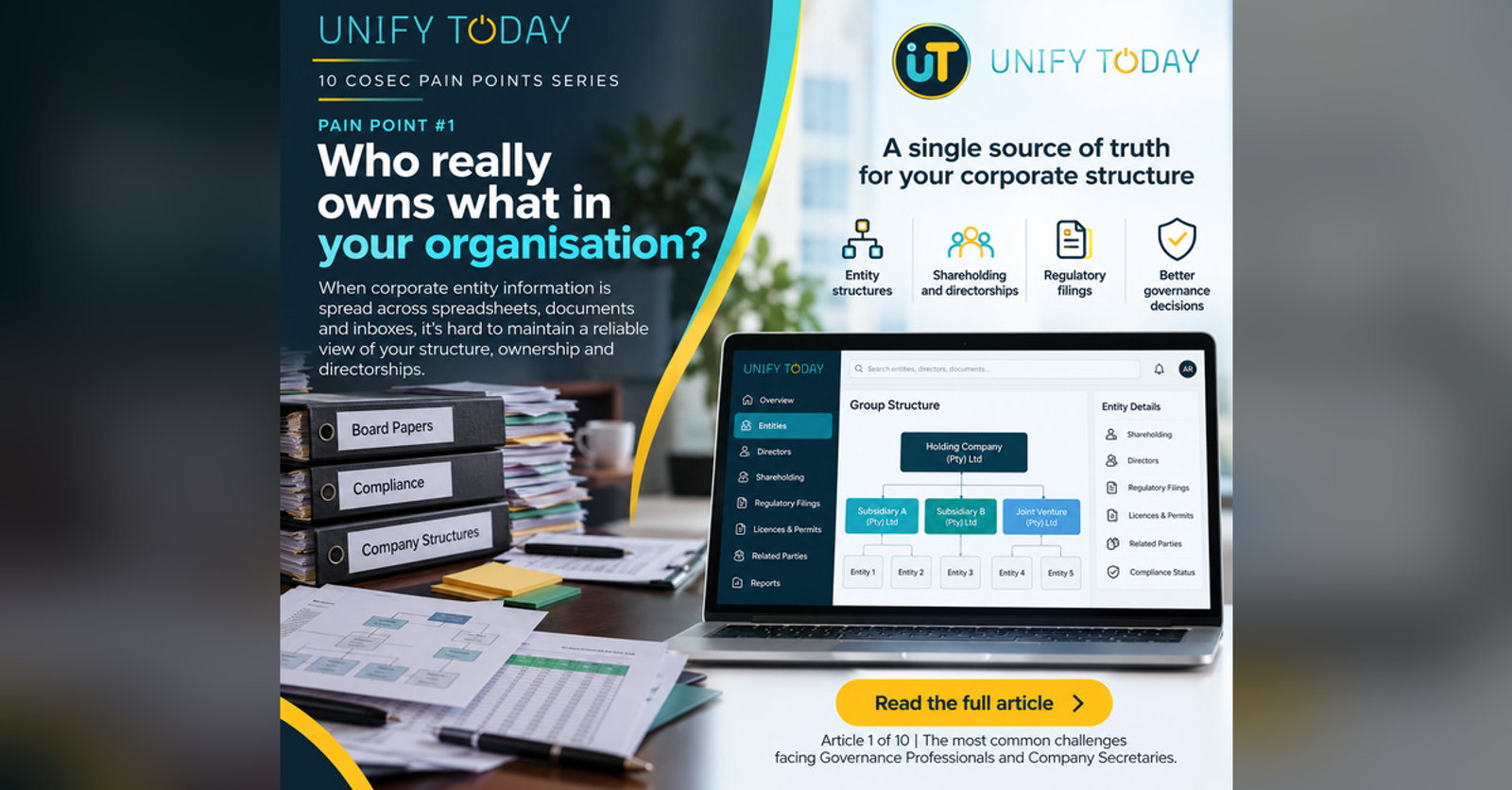
One organisation. Multiple subsidiaries. Countless spreadsheets. But is there a single, reliable view of your corporate structure?
For many Governance Professionals and Company Secretaries, maintaining an accurate picture of an organisation's legal entities, shareholding, directorships and related parties is far more complicated than it should be.
Corporate structures are constantly evolving. Directors change, shareholdings shift, new subsidiaries are established, and mergers or acquisitions introduce further complexity.
Yet, in many organisations, this critical information is still maintained across Word documents, Excel spreadsheets, PowerPoint diagrams and disconnected registers.
The challenge is not simply keeping records up to date. It is ensuring that the right information is available to the right people, at the right time, to support sound governance and informed decision-making.
When the corporate structure becomes a governance risk
Consider a common scenario.
The Board requests an updated view of the group's corporate structure ahead of a strategic decision.
The Company Secretary needs to confirm the latest shareholding, verify directorships, identify related parties and ensure that relevant corporate records are accurate.
What should be a straightforward request becomes an exercise in locating documents, reconciling different versions and verifying information with multiple stakeholders.
Now imagine the same challenge during a merger, acquisition, regulatory filing or due diligence exercise, when the consequences of outdated information can be far greater.
An outdated corporate structure is not just an administrative inconvenience. It can create compliance, financial and reputational risk.
Why effective entity management matters
Corporate entity management extends well beyond maintaining an organisational chart.
It provides the foundation for understanding how companies within a group are connected, who owns and controls them, who is responsible for their governance, and which regulatory obligations apply.
When this information is fragmented, several challenges emerge:
- Limited visibility: Different departments may rely on different versions of the corporate structure.
- Compliance exposure: Regulatory filings, licences and permits may be overlooked or not updated when corporate details change.
- Inefficient corporate transactions: Due diligence and mergers or acquisitions require additional effort to verify information.
- Related-party risks: Identifying relationships and potential conflicts becomes more difficult.
- Decision-making uncertainty: Without clarity on entity structures and delegated authority, decisions may not be directed to the appropriate entity or approval level.
For governance professionals, the result is often more time spent maintaining and validating information, and less time available for proactive oversight.
Moving from static diagrams to intelligent entity management
At UnifyToday, we believe corporate structures should be more than static diagrams.
They should form part of a connected, intelligent governance environment that supports regulatory compliance, corporate actions and decision-making across the organisation.
Our Governance and Company Secretarial solution brings entity information together within a centralised platform, providing a single source of truth that can be maintained and accessed across relevant business functions.
This changes how organisations can manage their corporate structures.
1. A clear, connected view of the organisation
Visualise subsidiaries, shareholding, directorships and related entities within a consolidated corporate structure.
Changes can be reflected centrally, reducing reliance on multiple documents and disconnected records.
2. More effective corporate compliance
Link regulatory filings, licences and permits to the relevant legal entities.
Structured workflows, notifications and reminders help teams proactively manage obligations rather than react to missed deadlines.
3. Greater efficiency during corporate transactions
Whether preparing for a merger, acquisition, restructuring or due diligence exercise, having reliable entity information readily available can significantly reduce administrative effort and improve the quality of information provided to stakeholders.
4. Better visibility of related-party relationships
Connected corporate structures help governance teams identify relationships between entities, supporting the review of related-party transactions and associated regulatory obligations.
5. Governance aligned with delegated authority
A clearer understanding of the legal entity structure helps ensure that decisions and approvals are directed to the appropriate entity, in line with the organisation's Delegation of Authority Policy and Framework.
6. Proactive management of directors and ownership changes
Changes to directorships, shareholding and company details can be managed through structured processes, supported by verification checks against sources such as CIPC and Home Affairs where applicable.
This helps keep corporate information current while supporting the identification of potential conflicts and governance concerns.
From recordkeeping to proactive governance
The real value of effective entity management is not simply having a more accurate corporate structure.
It is what organisations can do with that information.
When entity records, ownership relationships, directorships and regulatory obligations are connected, governance professionals are better equipped to anticipate issues, support strategic decisions and provide meaningful oversight.
Instead of spending hours establishing which version of a corporate structure is correct, they can focus on understanding what has changed, what it means and what action is required.
That is the shift from administrative recordkeeping to proactive governance.
One source of truth. Better governance decisions.
Corporate entity management should not depend on who has the latest spreadsheet or whether someone remembered to update a PowerPoint diagram.
It should be a connected, continuously maintained source of information that supports the entire organisation.
At UnifyToday, our intelligent Governance and Company Secretarial solution is designed to make that possible.
A question for Governance Professionals and Company Secretaries:
How confident are you that your organisation has one accurate, up-to-date view of its corporate entities, shareholding and directorships?
And how much time does your team spend maintaining that picture?
We would welcome your perspective in the comments.
This is Article 1 of our 10-part series exploring the most common challenges facing Governance Professionals and Company Secretaries, and how a more connected approach can help.
Next in the series: COSEC Pain Point #2: When Shareholder Intelligence Falls Behind Reality.
To learn more about UnifyToday's Governance and Company Secretarial solution, visit www.unifytoday.tech or contact us to arrange a demonstration.
#CorporateGovernance #CompanySecretariat #COSEC #EntityManagement #Governance #GRC #UnifyToday
About the author
Unify Today Editorial
GRC Insight Team